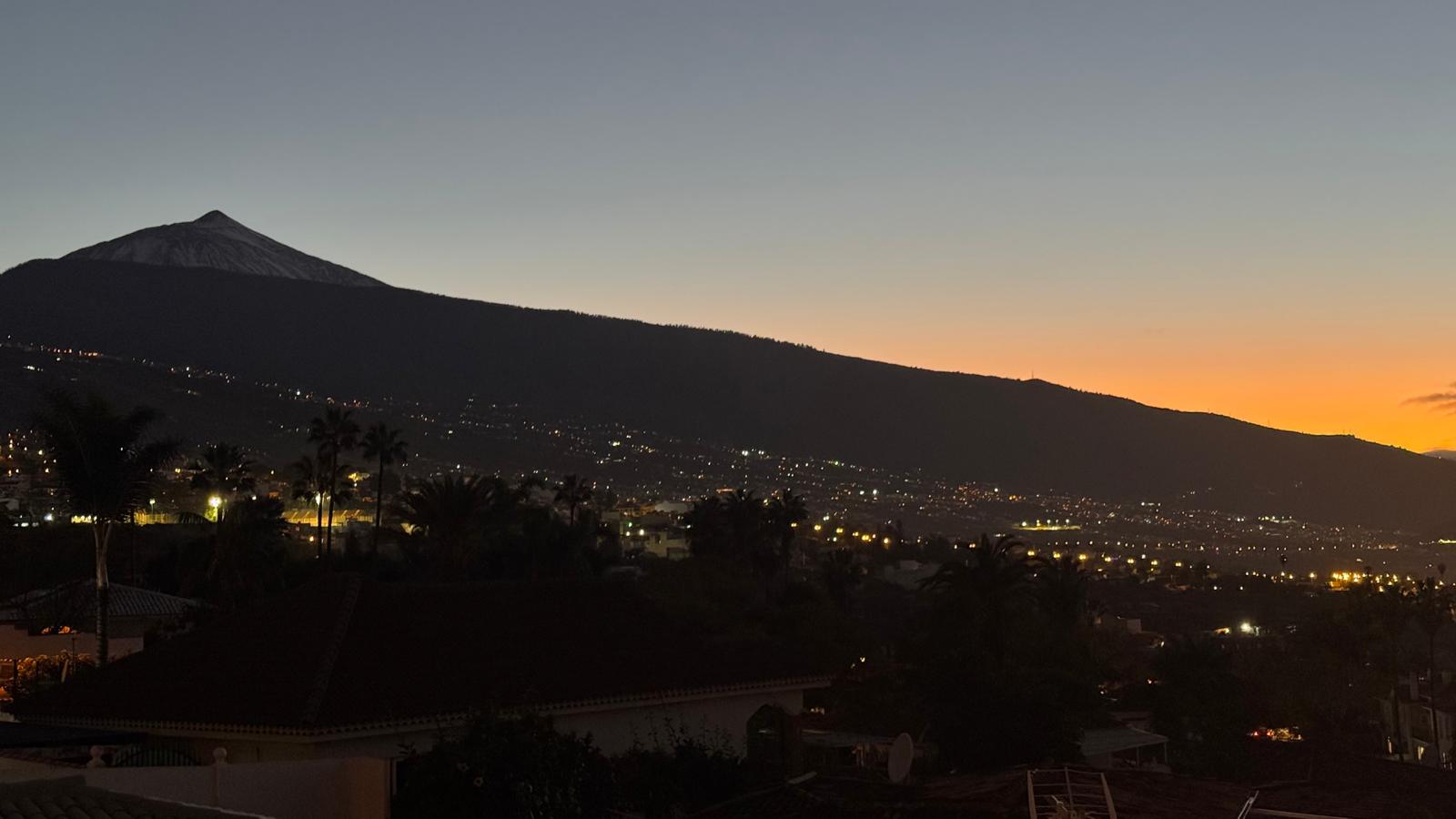
Standing watch over Tenerife like an ancient sentinel, Mount Teide commands attention. At 3,715 meters, Spain’s highest peak dominates the island’s skyline, and nowhere is this more dramatic than when viewed from the Orotava Valley as day surrenders to night.
A Volcano’s Silhouette
As the sun descends toward the Atlantic, Teide transforms into a perfect silhouette—a volcanic cone so symmetrical it seems almost sculpted. The mountain’s dark profile rises against a gradient sky where deep blues melt into warm oranges and golds. This is the moment when Teide’s true scale becomes apparent, its massive shoulders dwarfing everything around it.
The volcano’s presence is both humbling and reassuring. Dormant since 1909, Teide has shaped this island’s landscape, climate, and character. The volcanic soils on its slopes have nurtured the pine forests that cascade down toward the valley, creating Tenerife’s distinctive ecological zones.
The Valley Below Awakens
As twilight deepens, the Orotava Valley reveals its own magic. Thousands of lights begin to sparkle across the settlements below—La Orotava, Puerto de la Cruz, and the scattered towns that stretch toward the coast. These twinkling points of civilization create a stunning counterpoint to Teide’s wild majesty, a reminder that humans have learned to thrive in the shadow of this giant.
Palm trees in the foreground frame the scene, their dark fronds adding a tropical touch to this uniquely Canarian landscape where Africa, Europe, and Atlantic island cultures converge.
The Perfect Moment
This view captures what makes Tenerife extraordinary: the meeting of fire and ocean, mountain and valley, wilderness and civilization. As the last light fades behind Teide and the valley lights grow brighter, you witness the daily transition that has played out here for millions of years—long before the first humans arrived, and likely long after we’re gone.
This is Tenerife at its most elemental and beautiful.


Leave a Reply